Social stigma attached to Chernobyl survivors
Voices from ChernobylSocial stigma attached to Chernobyl survivors made the disaster persist in ordinary encounters long after evacuation: people were identified by where they came from, treated as possible sources of contamination, and judged through assumptions about their health and ability to have children. In the testimonies, the label Chernobylite names both a forcibly imposed difference and an identity some survivors try to reclaim, even as suspicion follows them into transport, school, courtship, employment, and medical care.
A Name That Replaced Ordinary Identity
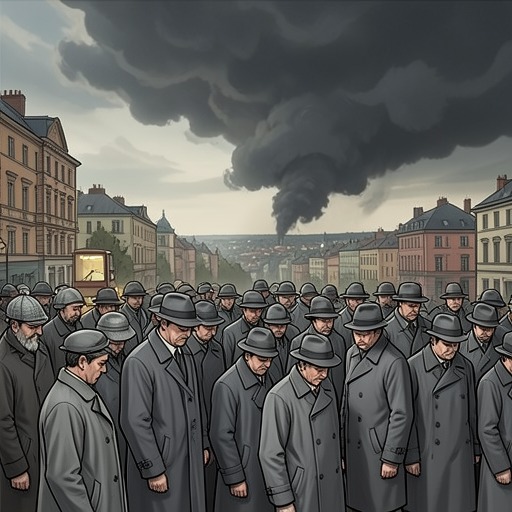
One former resident of Pripyat describes the transformation as a sudden loss of ordinary personhood. Before the disaster, life meant work, an average salary, and an annual vacation; afterward, he felt that others had turned him into a Chernobyl person, an animal-like curiosity whose experience everyone wanted to question but no one could understand. The questions he recalls—about the burning station, fear, and whether he could have children—reduce a complex life to the presumed effects of the accident. The name Chernobyl itself, he says, made people turn and look. His testimony links stigma to visibility: survivors could not simply resume an ordinary identity because their place of origin announced them to strangers.
That reduction also explains his insistence that he would tell only what was truly his. He rejects both the expectation that he can explain an incomprehensible event and the simplified, sensational image of Chernobyl as a house of horrors. The stigma is not only fear of contamination; it is also the demand that survivors serve as evidence, spectacle, or explanation for outsiders. His testimony describes being made into a subject of attention while remaining misunderstood.
Suspicion in Everyday Encounters
In one account of evacuation and resettlement, a family traveling to Minsk had to pay three times the usual price for train seats. The conductor brought tea to the other passengers but asked the family for its cups after learning that they came from Chernobyl. At first, they thought the train had run short of cups; the explanation was fear of them. The small, practical gesture made an invisible danger socially legible as a reason to withhold ordinary hospitality.
The family encountered the same suspicion through its belongings. When the parents returned to their apartment, a blanket, a coat, and a collection of Chekhov’s works were among the things they retrieved. A stain on the blanket remained after washing and vacuuming; at the dry-cleaner, it was found to glow, and the affected piece was cut out. The speaker could no longer sleep beneath the blanket or wear the coat—not simply from fear, but from hostility toward objects that might have killed them. The episode complicates the social response: contamination was not imaginary, but fear attached itself to people and possessions alike, turning ordinary objects into reminders of danger and estrangement.
For one displaced family in Mogilev, exclusion reached a child’s classroom. Their son, in fourth grade and the only child from Chernobyl in his class, was rejected as a seatmate by a girl who called him radioactive. Other pupils called him Shiny. His first day ended in tears, and his mother understood that his childhood had been cut short. The account shows how a label that began with adults’ anxieties could be repeated among children, converting an involuntary origin into a mark of shame and social isolation.
Intimacy and the Fear of Having Children
The stigma entered courtship as a judgment about reproductive risk. A former cleanup worker describes going dancing after returning home and approaching a woman he liked. She rejected him because he was a Chernobylite and she feared having children with him. The episode makes the social consequence direct: the disaster follows a survivor into the possibility of a relationship, where an uncertain or feared future becomes grounds for refusal.
A young woman describes a related fear from the other side of the relationship. She had a fiancé and had already registered their plans, but his mother asked whether she would be able to have children after learning that she came from a Chernobyl family and was a refugee. Her fiancé offered to leave home and rent an apartment with her; still, the mother’s question altered the meaning of love. The woman describes herself as one of the Chernobyl Hibakusha, invoking the survivors of Hiroshima to name a group who, in her view, existed even when people around them did not speak of them. She had come to fear loving someone because she feared the consequences others attached to her origin.
An earlier relationship had already taught her to distrust the gaze of people who approached disaster survivors as material for fascination. Her artist boyfriend had asked about the fire at the station and about dead animals; after hearing his excited response to a story of a suicide, she could no longer remain with him. She felt that he wanted to observe and remember her as if an experiment were underway. Her suspicion extended to an interviewer as well. This account connects reproductive stigma with a broader unease: attention to survivors can become a form of objectification, particularly when curiosity about catastrophe outweighs recognition of the person speaking.
A mother’s testimony about her four-year-old daughter shows how illness and social recognition could burden an entire family. The child had spent four years living in hospital and undergone operations to construct bodily openings; after complications, her parents were advised to seek treatment abroad, beyond their means. A professor suggested that the child’s pathologies might interest foreign hospitals and science. The mother wrote letters describing the care her daughter required and pleaded for a chance at treatment. Her account does not describe a specific act of public rejection, but it reveals the precarious position of families whose lives become defined by an abnormality associated with radiation: they must seek help while confronting the possibility that their child will be regarded as a scientific case. The mother also fought for four years to obtain medical confirmation linking the girl’s condition to radiation, after doctors repeatedly classified it as a congenital handicap.
Work, Secrecy, and Social Recognition
For cleanup workers, the identity could bring danger without reliable recognition or support. One soldier recalls signing a nondisclosure form and remaining silent about his assignment. He was twenty-two when he returned from the army and became a second-group invalid. He describes carrying buckets of graphite from the reactor, shoveling with ordinary tools, and changing masks as many as thirty times during a shift. The sarcophagus, he says, covered the remains of Valery Khodemchuk, the senior operator trapped beneath the ruins in the first minutes after the explosion. Yet after the unit returned, the men were not even given a change of clothes; they wore the same trousers and boots they had worn at the reactor until demobilization. Their work was physically consequential, but secrecy and inadequate practical recognition followed them home.
The same worker later invoked his status when a factory boss threatened to reduce his work because of his illness. He protested that he had protected others, but the director replied that the factory had not sent him to Chernobyl. The exchange exposes a conflict between a survivor’s claim to public service and an employer’s refusal to accept responsibility for it. The worker also lacked documents showing his radiation dose, since records remained classified or had been destroyed. Without that proof, he could not readily explain his exposure to doctors or use official evidence to make his experience credible.
A separate testimony shows that the language of heroic service could coexist with pressure to treat people as expendable. A cameraman who had already been sent to the Zone was called in again; managers argued that the assignment mattered less for him because he had already been there and had children, while younger men remained unexposed. They promised a possible raise. This episode is not the same as the public fear directed at evacuees, but it belongs to the same unequal social landscape: being marked by prior exposure could make a person less protected, not more. Meanwhile, the accounts of soldiers guarding evacuated villages describe a different imposed boundary. They were ordered to keep former inhabitants out, while people on the other side begged to retrieve household objects and mourned their land. Such controls were presented as official tasks, but they deepened the separation between residents and the homes from which disaster had displaced them.
A Stigma That Outlasts Evacuation
The testimonies show stigma taking several distinct forms: avoidance, ridicule, fear of marriage and childbirth, intrusive curiosity, and denial of occupational responsibility. These responses did not all arise from the same motive, and they should not be collapsed into a single reaction. The train passengers’ fear of a family from Chernobyl, a child’s classmates calling him Shiny, and a factory director disclaiming responsibility each placed the survivor in a different relation to other people. Together, however, they show how a place of origin could become a lasting social boundary.
Survivors also spoke back to that boundary. The former resident who calls himself a Chernobyl person insists on his own truth rather than accepting a ready-made image of the disaster. The young woman names the Chernobyl Hibakusha, making a shared identity visible even where public discussion is absent. The cleanup worker claims the standing of someone who protected others, despite an employer’s denial. Their accounts do not erase fear, illness, or exclusion; they record the effort to insist that those marked by Chernobyl remain people with work histories, attachments, families, and claims to recognition.